
LAP-F1-64 Deep Memory Logic Analyzer, 512M per Channel
Deep memory logic analyzer: LAP-F1-64 with 512M per channel, folding to 1G at 32 channels, plus USB 3.0 long-time recording.
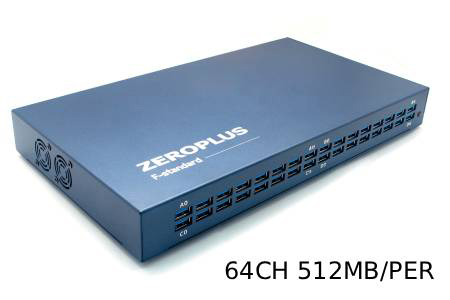
64-Channel Ultra-Deep Memory Logic Analyzer
LAP-F164512M | FM00006159
512M Deep Memory, Engineered for Long-Time Capture and Complex Digital System Troubleshooting.
The 64-Channel Ultra-Deep Logic Analyzer features a high-end configuration combining 64 synchronized channels with a 512M per-channel memory depth, specifically engineered for complex system troubleshooting and deep data tracking. Equipped with an ultra-high-speed core and next-generation active probes, it significantly reduces signal distortion and provides precision measurements up to 2GHz. Its massive storage capacity supports high-density multi-bus analysis and long-duration recording, ensuring 100% capture of subtle anomalies during high-speed switching. This model meets the most rigorous R&D demands for massive data acquisition and detailed protocol observation, making it the ultimate tool for localizing intermittent errors and optimizing system performance.
Troubleshooting Low Communication Efficiency in a Three-Tier I2C Architecture
Measurement Description
- System Architecture: To be compatible with older analog modules, the product uses a three-tier I2C topology (Master → Slave/Master → Slave), where the second-tier MCU acts as both master and slave.
- Anomaly: After the product runs for 10 to 30 minutes, the overall communication efficiency significantly drops for unknown reasons.
Problem Resolution
Full-Time Monitoring of Three-Tier Bus:
● Used the LLTR function to synchronously record all communication processes across the three-tier I2C structure, ensuring no intermittent handshake protocol errors were missed.
Fault Localization and Exclusion:
● Stopped recording when efficiency dropped, and packet analysis revealed the problem originated from a specific Slave device in the third tier.
● This device experienced a voltage anomaly after prolonged operation, pulling the I2C Bus to a low potential (Low), causing the entire bus to enter a Wait State and consequently slowing down the overall system performance.
Features
- 64-Channel Synchronous Monitoring: Ideal for high-pin-count components and simultaneous parallel observation of multiple buses.
- 512M Memory Depth: Engineered for long-duration data capture and complex system troubleshooting.
- Next-Generation Active Probes: Significantly enhances measurement stability and signal integrity for high-speed signals.
- Up to 2GHz Internal Timing Sampling: Provides ultra-high resolution for precise timing analysis of high-speed transitions.
- Advanced Hardware Triggering: Enables rapid localization of specific events and critical timing points.
- Comprehensive Protocol Support: Free access to over 130 bus protocol decoders for versatile analysis.
- ZP-Logic Software Integration: Facilitates multi-signal synchronous analysis and deep packet-level observation.
Applications
- Embedded System Development: Simultaneously monitor UART, SPI, and I2C across multiple channels to analyze the intricate interactions between Microcontrollers (MCUs) and peripheral devices.
- Automotive Electronics & Telematics: Combine CAN 2.0B, FlexRay, and LIN protocols for long-term stability monitoring of In-Vehicle Infotainment (IVI) systems.
- Semiconductor & High-Speed Storage Testing: Utilize dedicated eMMC 5.1 and SD 3.0 probes to perform rigorous timing verification of storage controllers in HS400 mode.
- Industrial Automation & Control: Ensure real-time precision and reliability in automated production lines by verifying industrial-grade protocols such as ModBus, PROFIBUS, and EtherCAT.
- Power Management Analysis: Leverage PMBus and SMBus protocols to monitor complex Power Distribution Networks (PDN) and management logic on server motherboards.
- Smart Home & IoT R&D: Support 1-Wire, Infrared (IR), and other specialized protocols to facilitate the development of low-power sensors and intelligent remote control systems.
Specifications
| Sampling Rate | ● Internal (Timing) (Asynchronous): 2 GHz (Max) ● External (State) (Synchronous): 200 MHz (Dual-edge) |
| Active Probes / Signals | P120LV ● DUT Bandwidth (Max.):120 MHz ● Channels (Max.):Data 64 ch ● Signal Type:Single-Ended Bus ● Input Impedance / Capacitance:190 Kohm ± 10% / 4.3 pF ±2 pF ● Bus Voltage:VIH:0.6V - 5V ● Input DC Voltage (Max.):± 10V P300ST (Based: 1 ch (CLK). Other options) ● DUT Bandwidth (Max.):200 MHz ● Channels (Max.):Data 32 ch ● Signal Type:Single-Ended Bus ● Input Impedance / Capacitance:190 Kohm ± 10% / 4.3 pF ±2 pF ● Bus Voltage:VIH:0.6V - 5V ● Input DC Voltage (Max.):± 10V |
| Memory | Memory Depth Per Channel (Bits) / Channels 4M / 64 ch 8M / 32 ch 16M / 16 ch 32M / 8 ch 64M / 4 ch 128M / 2 ch 256M / 1 ch 64M / 64 ch 128M / 32 ch 256M / 16 ch 512M / 8 ch 1G / 4 ch 256M / 64 ch 512M / 32 ch 1G / 16 ch 512M / 64 ch 1G / 32 ch |
| Trigger | ● 6 protocol triggers (hardware) (serial):I2C, I2S, SPI, SVID, UART (RS-232C/422/485), CAN 2.0B ● Trigger types:Pattern / Edge / Pulse-Width / Interval ● Trigger channels:64 ● Trigger delay:Yes ● Trigger levels:256 ● Trigger pass:1-65535 |
| Operating System | Windows (11/10/8.1/7) |
| Special Software Features | ● Zooming and panning ● Waveform and UI Customization ● State list and Waveform view ● Packet list ● Waveform Navigator ● Memory view ● Statistic ● File Comparison |
| Phase Error | < 3ns |
| Power Supply | AC (IN):100 ~ 240V, 50 ~ 60Hz DC (OUT):9V / 5.55A |
| Certifications | FCC / CE / WEEE / RoHS / REACH |
- Gallery
-
-
 SoundWire packet list
-
 Quad SPI packet list
-
 FCC
-
 RoHS
-
 CE
-
 CB
-
 REACH
-
 WEEE
-
- Video
- Download
-


 Download
Popular Products

Keeping Rare Events Inside One Capture
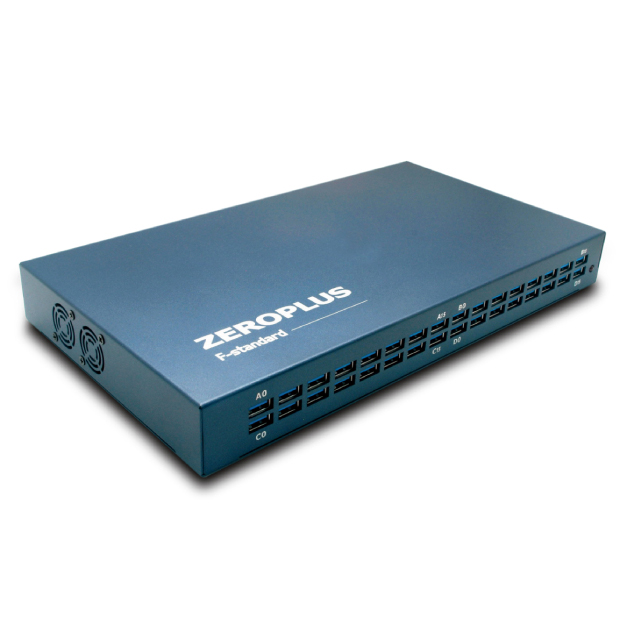
The LAP-F164512M is the LAP-F1-64 with its largest memory option: 512M bits per channel across 64 channels, rising to 1G per channel at 32 channels when folded. Deep memory keeps a rare or widely spaced event inside one capture at full timing resolution, with LAP-F1 sampling at 2 GHz in timing mode and 200 MHz (dual-edge) in state mode. The LAP-F1 series lists more than 130 built-in protocol decoders and six hardware trigger protocols.
For events spread over longer periods, LAP-F1-64 long-time recording streams to a hard drive over USB 3.0 for hours or days rather than filling on-board memory. The LAP-F1-64 uses an external power adapter and lists FCC, CE, WEEE, RoHS and REACH in its specifications. To choose between deep memory and recording, estimate how long the fault takes to appear; if 40 channels are enough, compare the LAP-F1-40 with 512M per channel.